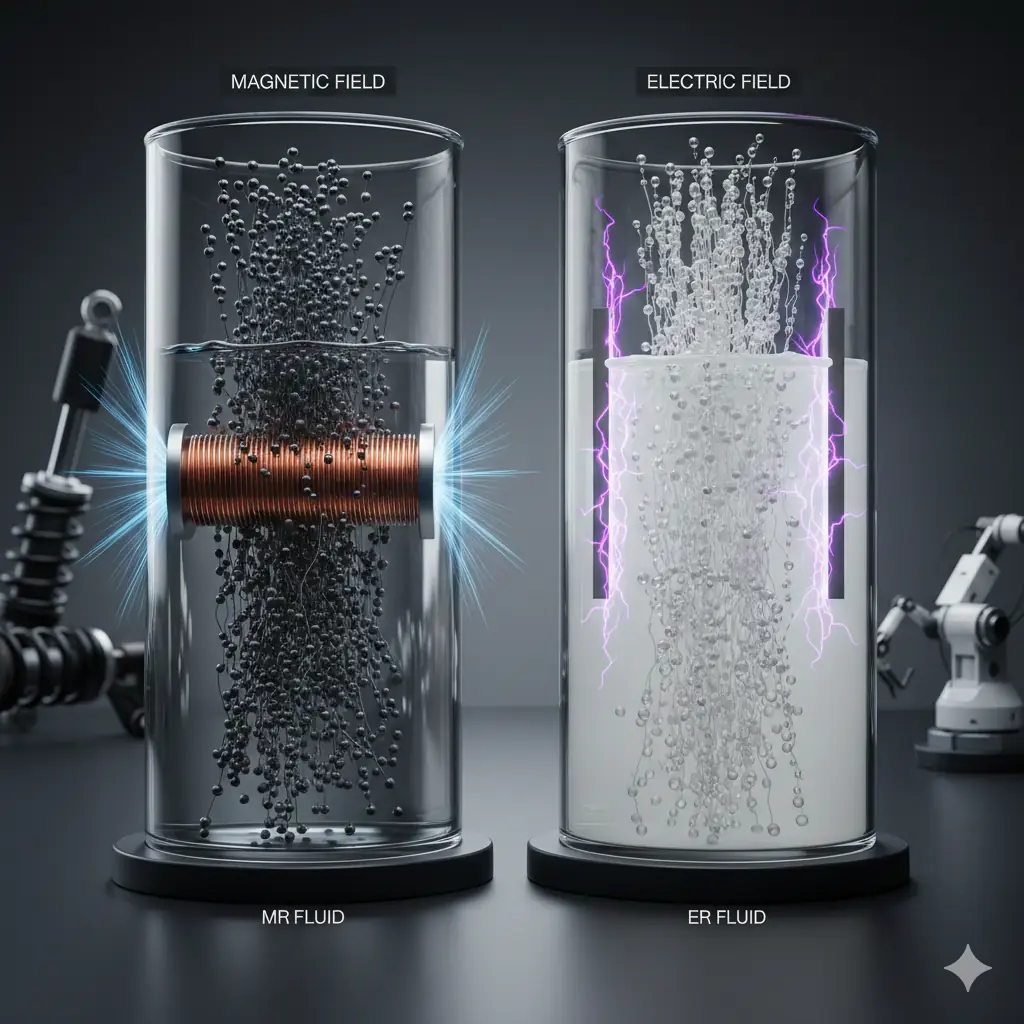
In the world of advanced engineering, the search for materials that can instantaneously adapt their mechanical properties is relentless. This quest has led to the emergence of smart fluids, a fascinating class of materials whose properties can be controlled by external fields. Chief among these are Magnetorheological (MR) and Electrorheological (ER) fluids.
These fluids are not just scientific curiosities; they are foundational to the next generation of adaptive actuation, promising faster response times and more precise control in devices ranging from car suspensions to prosthetic limbs. Understanding how they work is key to appreciating their potential.
—
How Smart Fluids Achieve Control
At their core, both MR and ER fluids are colloidal suspensions. They consist of micron-sized, active particles suspended within a non-conductive, inert carrier fluid, such as mineral or silicone oil. Their ‘smart’ behavior stems from the way these dispersed particles react to an applied field.
When the field is absent, the particles remain randomly suspended, and the fluid flows freely, much like a simple liquid. However, upon activation, the particles quickly polarize and align themselves into strong chain-like or columnar structures along the direction of the applied field.
This rapid microstructural change transforms the fluid from a free-flowing liquid into a viscoelastic, solid-like material. The force required to break these internal chains is known as the yield stress, which can be continuously and reversibly controlled by adjusting the intensity of the external field.
—
Magnetorheological Fluids: Magnetic Control
Mechanism of MR Fluids
Magnetorheological (MR) fluids utilize a magnetic field for their state change. The dispersed particles are typically highly magnetizable materials, like carbonyl iron powder. When a magnetic field is applied, the induced magnetic dipoles cause the particles to rapidly chain together.
The strength of the resulting solid-like state, and thus the fluid’s ability to resist flow, is directly proportional to the magnetic field intensity. This effect is powerful and robust, offering a substantial change in yield stress—sometimes up to 50–100 kPa.
MR Fluid Advantages and Applications
A major advantage of MR fluids is their high yield stress and their relative insensitivity to contaminants or temperature fluctuations, which makes them robust for industrial use. They also operate with low-voltage, high-current power supplies, making the control systems straightforward.
The most widespread commercial application is in semi-active dampers and shock absorbers, like those found in high-performance vehicles such as the Cadillac CT5-V Blackwing. By varying the magnetic field, the suspension can instantly stiffen to provide stability during a sharp turn or soften for a comfortable highway ride. MR fluids are also used in controllable clutches and brakes.
—
Electrorheological Fluids: Electric Control
Mechanism of ER Fluids
Electrorheological (ER) fluids, on the other hand, rely on an electric field. Their dispersed particles are dielectric or semi-conducting materials. Applying an electric field induces electrical polarization, which drives the particles to form chains between the electrodes—an effect often called the Winslow effect.
Like MR fluids, the magnitude of the yield stress is tunable by varying the electric field strength. Their core distinction is that they require a high-voltage, low-current power supply, in contrast to the magnetic systems.
ER Fluid Advantages and Applications
The primary advantage of ER fluids is their ultra-fast response time, often in the millisecond range, making them incredibly dynamic. While traditional ER fluids historically offered a lower yield stress compared to MR, modern advances, such as Giant Electrorheological (GER) fluids, are significantly closing this gap.
ER fluids are promising for applications demanding high speed and precision, such as small-scale microfluidic devices and haptic feedback systems, including tactile displays. They are also explored for use in vibration control for civil structures and in highly responsive micro-actuators in robotics.
—
Comparative Analysis of Smart Fluids
When selecting a smart fluid for an application, engineers weigh the trade-offs between magnetic and electric control. The choice usually depends on the specific demands of the system.
MR fluids are the current commercial favorite where high force transmission is paramount, such as in heavy-duty truck seating suspensions or seismic dampers in buildings. They offer superior yield stress with relatively low power consumption for the control system itself.
ER fluids are generally favored in environments where the response speed is the absolute most critical factor, often in fine-motor control or sensing applications. However, they also face challenges related to particle sedimentation and the need for robust sealing against the high operating voltages.
—
The Future of Adaptive Actuation
The continuous development of these smart fluids is focused on overcoming their current limitations, such as the long-term stability and temperature sensitivity of the materials. Researchers are working to create new particle formulations that increase yield stress, reduce sedimentation, and broaden the operational temperature range.
The synergy between smart fluid technology and advanced control algorithms—often involving real-time microprocessors and sensors—is key to their success in the field of adaptive actuation. Systems can now react to changing conditions in milliseconds, far exceeding the capability of purely mechanical or passive systems.
For instance, in the aerospace industry, smart fluids could enable wing flaps that instantly change their aerodynamic profile based on turbulence, offering both increased fuel efficiency and greater safety. This capability to actively manage mechanical properties marks a true revolution.
—
Key Statistics and Figures
- Response Time: Both MR and ER fluids typically achieve a state change in under 10 milliseconds.
- Yield Stress (MR): Commercial MR fluids can achieve yield strengths of 50–100 kPa in the presence of a magnetic field.
- Power Control: MR devices use a low-voltage (e.g., 12–24 V) power supply; ER devices require a high-voltage (e.g., 1–5 kV/mm) supply.
- Force Amplification: Smart fluid devices are excellent power amplifiers, where a small amount of control power dictates a large amount of mechanical power output.
—
As research progresses, the lines between MR and ER performance will likely blur, and highly optimized smart fluid systems will become ubiquitous. These materials are transitioning from laboratory novelties to mainstream engineering tools, underpinning a future where mechanical systems are not just reactive, but truly adaptive.